Free PageSpeed check for Singapore Shopify storesCheck your store now
64→100

Inlinex home page on Google's phone test, 12 Oct and 30 Oct 2026.

57→86

A product page with a YouTube video in its description.

1.9 s

Main content for real visitors. Google's Core Web Vitals check: passed. Read the case study

Why your PageSpeed result matters on Google

Google uses page speed when it ranks pages, and slow pages lose buyers before they decide.

  1. Google ranks on speed. Google says Core Web Vitals "are used by our ranking systems". They measure how fast real visitors see your page, how quickly it answers a tap, and whether it jumps. They're the top block of every PageSpeed Insights report.
  2. It can decide close calls. Relevance comes first: speed won't rank a page that doesn't answer the search. When your page and a competitor's answer it equally well, the faster, steadier page has the edge.
  3. Slow pages lose the sale anyway. As a page goes from 1 to 3 seconds to load, the chance a visitor leaves rises by 32% (Google). A mobile site 0.1 s faster lifted retail conversions by 8.4% (Deloitte study for Google, 37 brands).
  4. The score shows what to fix. The 0-100 number is one simulated phone test, so it isn't what Google ranks on by itself. But a low score points at the same apps and scripts that slow real phones down, and fixing those helps both.

Sources: Google Search Central, Think with Google, Deloitte via web.dev.

Real visitors, last 28 daysGoogle ranks on this

Core Web Vitals: Passed

Main content shows LCP
1.9 s
Answers a tap INP
123 ms
Page jumps CLS
0
Lab test, one simulated phoneShows what to fix

Performance finds the files that hold real visitors up. Open Google's report

Inlinex in PageSpeed Insights after our fixes: real visitors on 1 Nov 2026, lab test on 2 Nov when it started on time.

Late first frames come in whole seconds.

63 test runs of the Inlinex home page in October. The first frame came at about 0.3 s, 1.35 s or 2.4 s, never in between. No late run scored above 83.

Score
On time
1 s late
2 s late
100
90
75
50
0 s
1 s
2 s
3 s
When the first frame was drawn
On time45 runs, scores 68-95
1 s late5 runs, scores 63-64
2 s late13 runs, scores 54-83
page as it was same page, one file blocked for a testgreen = 90 or more
See the numbers
StartFirst frameRunsScores
On time0.25-0.59 s4568-95
1 s late1.34-1.39 s563-64
2 s late2.31-2.50 s1354-83

63 Lighthouse runs of the Inlinex home page (phone, simulated slow 4G) from one PC in Singapore, 3-30 Oct 2026.

Then everything that downloaded counts against you.

PageSpeed counts every file that finished before the first frame as needed for it. So the work is simple to say: block the screen less, and download less early.

What we change

Each fix went live on Inlinex first, after testing it on Google's own machine.

  • App stylesheets load in the background

    A chat app's stylesheet was the usual trigger of the late start.

    home page 87 → 99-100 with the next two
  • Chat and session recording wait for the first touch

    They start the moment someone taps or scrolls, or 4 s after the page loads.

    Clarity alone was adding ~1 s
  • Cart drawer styles load in the background

    Nobody sees the drawer until they tap the cart, so the first frame shouldn't wait for it.

  • Videos load when scrolled near

    One attribute on the video frames in product descriptions.

    product page 57 → 86
  • Header and headline in one frame

    The home page's first frame becomes its whole first screen, not two half-frames.

  • Links skip the redirect

    Each hop costs about a second in Google's test, and real visitors wait for it too.

    16 menu links fixed

Website speed optimisation, measured on Google's own test

Most website speed optimisation starts with a speed app or a list of general tips: compress the images, minify the code, remove an app. Sometimes that helps. On a Shopify store it often barely moves the PageSpeed Insights score, because the score is decided by what happens before the first frame.

We work from measurements. For each store we read Google's real-visitor data (the Core Web Vitals that count for ranking), run your pages several times on Google's own PageSpeed machine, and find the files that hold back the first frame. Usually that's app stylesheets, chat and tracking scripts, video embeds and redirect hops. We fix those on a copy of your theme and prove the result before anything goes live.

We're in Singapore and start with Singapore Shopify stores: prices in SGD, replies on WhatsApp, and a real Singapore store as proof. If you're wondering why your PageSpeed score is low in the first place, the guide explains it with real test data.

Start with a free check. Decide after.

The check is free and takes about a minute. It shows what's slowing your store and how to fix each one. Fix it yourself, or have us do it.

Speed check

Free

About a minute, on screen. No sign-up.

  • Your Google PageSpeed score and real-visitor data
  • What holds up your first screen, file by file
  • Your heaviest apps and scripts, and which can safely wait
  • How to fix each one, in plain English
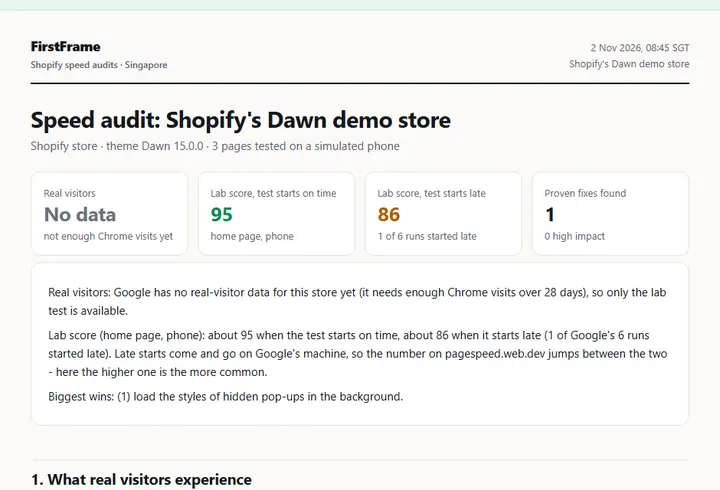
Page one of a sample FirstFrame audit report

Every fix comes with a full report like this one (Shopify's own demo store). Open it

Speed fixes

S$350 incl. GST

One-off. About a week.

  • A full audit first: 4+ Google runs on home, product and collection
  • Built on a copy of your theme, tested on Google's machine
  • Live only with your written OK, with a full backup and one-step undo
  • Before and after report, 3 days of support after going live

Speed care

S$50 a month, incl. GST

Minimum 6 months.

  • Monthly re-test, and a check after every new app or theme update
  • Up to an hour of fixes a month. After 6 months, cancel any time.

Pay online by card or PayNow. If the median of 4 or more Google runs on the fixed pages isn't higher than before, we undo the changes and refund the fix fee. Going ahead? Sign the service agreement online (read the terms).

Nothing changes on your store until you say so.

  1. Check your storeType your address at the top. Results on screen in about a minute.
  2. You decideFix it yourself with the tips, have us do it, or leave it. If real visitors already pass, we say so.
  3. Sign and pay onlineAbout two minutes, by card or PayNow.
  4. Fixes, on a copy firstTested on Google's machine, then live only with your written OK.

Tried on Google's own test. Didn't work.

These still turn up in speed guides. We won't charge you for them.

  • Render-blocking until the headlineWorked locally, then made Google's test start late 4 times out of 4.
  • Loading Google Fonts after the pageThe late first frame came after the load event anyway.
  • An extra preconnect hintOne on-time run out of two: no better than without it.
  • A tiny animation to keep frames comingLooked good once, then failed in fair side-by-side runs.
  • Hiding product pages until the photo loadsHelps a text headline, not a photo. Scores stayed at 86 and 81.
  • Judging a change on one runThe same page scores 65 or 85 depending on the start. We compare 4 or more.

Questions

Anything else: WhatsApp +65 8128 5873 or admin@inlinex.com.sg.

My score is 60 but my store feels fast. Who's right?

Probably both. The PageSpeed score simulates a slow phone, and it swings with how Google's test starts. What your customers experience is measured separately from real Chrome visits, and that's what Google uses for ranking. The audit shows you both.

You got me to 100, now it says 95. Did something break?

Probably not. Google's test runs on shared computers and loads your apps at slightly different moments each time, so the same page can score 100, then 95, then 98, with nothing changed. It's like timing the same lap ten times: you never get exactly the same time. That's why we judge on the middle of 4 or more runs, before and after, and that's the number we promise to raise. If the score drops and stays down across several runs, something did change, often a new app or a big new image: tell us and we'll find it.

Will a higher score improve my Google ranking?

Google's ranking uses real-visitor Core Web Vitals, not the lab score. If your real visitors already pass, don't expect a ranking jump. The fixes still help phones on slow connections, and they end the "why is our score 60" worry.

How much does website speed optimisation cost in Singapore?

With us: the check is free, fixes are S$350 once, and speed care is S$50 a month with a 6-month minimum, all including GST. Singapore agency guides put a basic speed fix at S$500-1,500 and a full one at S$2,000-5,000.

How long does it take?

The check takes about a minute. Fixes take about a week, most of it testing on Google's machine before anything goes live.

Do you need my Shopify password?

No. The check needs only your web address. For fixes we send a collaborator request from our Shopify Partner account asking for two permissions only: Themes and Edit code (plus Navigation if menu links need fixing). It doesn't use one of your staff seats, can't see orders, customers or payments, and you remove it when we finish.

Will my apps still work?

Yes. Chat bubbles and session recorders may start a moment later, at the visitor's first touch or after a few seconds. Nothing is removed.

Will it affect my Facebook or Google ads tracking?

Not unless you ask. We never change pixels or analytics without your OK for that tool by name.

Do you work on WordPress or custom sites?

Not yet. The method is proven on Shopify, so that's where we start.

Send us your store's address.

We'll reply within a working day with what we'd test and when the report will be ready. You'll be dealing with the team behind Inlinex, the Singapore skate shop whose own store went from the 60s to 100 with these fixes.